Goat Breeds Chart: Complete Guide to 25+ Breeds with Pictures (2026)
Compare all major goat breeds in one comprehensive chart. Includes dairy, meat, fiber, and pet goat breeds with size, purpose, temperament, and care requirements.

Elma K. Johnson
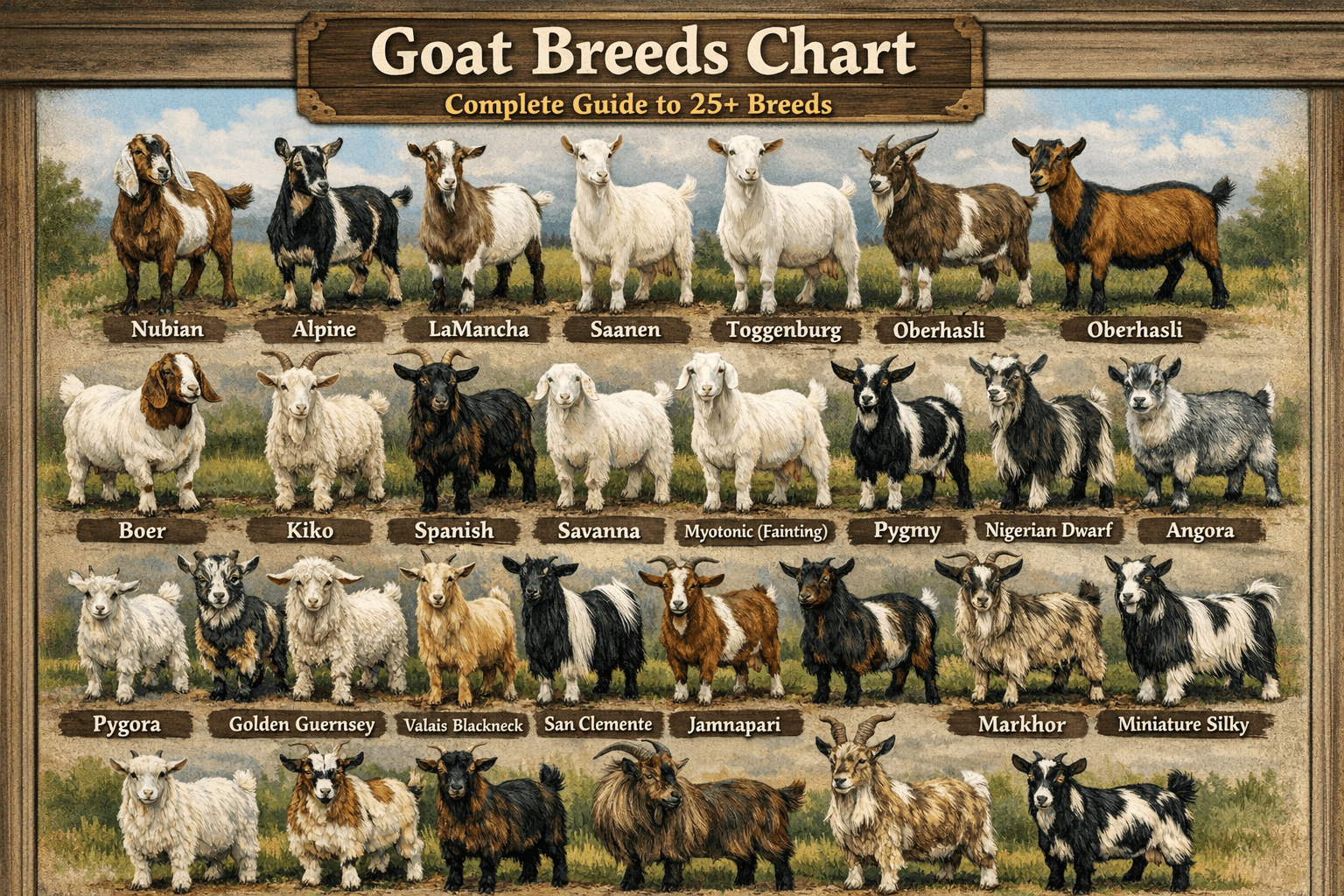
Choosing a goat breed is one of the most important decisions you'll make when starting with goats, yet it's surprisingly easy to get wrong. People fall in love with a breed's appearance or availability without considering whether it actually fits their goals, their property, or their lifestyle. The result is frustration for the owner and a goat that isn't thriving in its circumstances.
The world has over 300 recognized goat breeds, but most fall into four functional categories: dairy, meat, fiber, and companion animals. Understanding these categories—and where specific breeds fall within them—simplifies the selection process considerably. A dairy goat in someone's backyard who wanted a low-maintenance pet is as poorly placed as a Pygmy in someone's commercial cheese operation.
This guide covers the major breeds you'll encounter in North America, organized by purpose with detailed information on what makes each breed distinctive.
Understanding Breed Categories
Before diving into specific breeds, it helps to understand what each category actually means in practice.
Dairy breeds have been selected over generations for milk production. This means udder development, milk volume, lactation length, and milk composition. It also means these goats require more intensive management—regular milking schedules, higher nutrition, and more hands-on care. You can't just put dairy goats on pasture and forget about them. If you want milk, you need to commit to the work that comes with it.
Meat breeds prioritize rapid growth, muscling, and efficient feed conversion. They're generally hardier than dairy breeds because meat production systems often involve less intensive management. A good meat goat should thrive on pasture with minimal supplemental feeding, gain weight quickly, and produce offspring that do the same.
Fiber breeds produce mohair, cashmere, or other valuable fibers. They require regular shearing and more grooming maintenance than other goats, but they offer a renewable product that can generate income without harvesting the animal itself. Fiber production suits patient owners who enjoy the craft aspects of animal husbandry.
Companion breeds—primarily Pygmies and Nigerian Dwarfs—are optimized for temperament and manageability rather than production. They're the breeds most likely to act like pets rather than livestock, though this distinction blurs since many dairy goat owners also consider their animals companions.
The Major Dairy Breeds
Dairy goats represent the largest category of registered goats in America, and for good reason. Fresh goat milk is unavailable in most grocery stores, homemade goat cheese requires no special equipment, and the satisfaction of producing your own dairy surpasses what any commercial product can offer.
Saanen: The Volume Producer
Saanens are the Holstein cows of the goat world—large white animals bred for maximum milk output. A good Saanen doe produces one to three gallons daily, more than most families can actually use. They're calm, gentle, and well-suited to commercial dairy operations where consistency matters.
The trade-off for all that production is size. Saanens stand 30 to 35 inches tall and weigh 135 to 170 pounds. They need more space, more feed, and sturdier fencing than smaller breeds. Their all-white coloring also makes them susceptible to sunburn in areas with intense sunlight.
Saanens make sense for anyone serious about dairy production at scale, but they're more goat than most backyard operations need.
Alpine: The Versatile Choice
Alpines originated in the French Alps, and that mountain heritage shows in their hardiness and adaptability. They're strong producers—one to two gallons daily—while being more adaptable to varied climates than some other dairy breeds. Their production remains consistent across seasons, and they handle both heat and cold reasonably well.
Unlike Saanens, Alpines come in virtually any color pattern, which appeals to owners who want visual variety in their herd. Their temperament leans toward active and curious, sometimes described as "bossy" within a herd. They're excellent goats for all-around dairy use, particularly in climates with seasonal extremes.
Nubian: The Butterfat Champion
When people imagine a goat, they often picture a Nubian—long pendulous ears, Roman nose, and a vocal personality. Nubians originated in Africa and the Middle East, where their heat tolerance made them valuable in warm climates.
Nubians don't produce as much milk by volume as Swiss breeds like Saanens or Alpines—typically half a gallon to a gallon and a half daily. But their milk tests at 4 to 5 percent butterfat, significantly higher than the 3 to 4 percent of most dairy breeds. This richness makes Nubian milk ideal for cheese, where butterfat translates directly to yield and quality.
The breed's vocal nature is legendary. Nubians will call to their owners, to other goats, and seemingly to themselves. Some people find this endearing; others find it grounds for neighbor complaints. Know your tolerance for noise before committing to Nubians.
LaMancha: The Calm Producer
LaManchas are immediately recognizable by their tiny "elf ears" or nearly absent "gopher ears"—a distinctive trait that makes some people love them and others uncomfortable. Setting appearance aside, LaManchas are among the calmest, most even-tempered dairy goats available.
Their milk production is consistent and reliable, typically one to two gallons daily with around 4 percent butterfat. They're quieter than Nubians, less bossy than Alpines, and generally easier to manage for people who want dairy without drama. Their American origins (despite the Spanish-sounding name) mean they're well-adapted to North American conditions.
Nigerian Dwarf: The Small-Scale Solution
Nigerian Dwarfs prove that good things come in small packages. Standing just 17 to 21 inches tall, they're the smallest recognized dairy breed—yet they produce one to two quarts daily of milk testing at an astounding 6 to 10 percent butterfat, the highest of any goat breed.
This combination of small size and high-quality milk makes Nigerian Dwarfs ideal for backyard dairy operations. They need less space, less feed, and less robust fencing than full-sized dairy goats. Their milk, though modest in quantity, makes excellent cheese and soap.
Unlike most dairy breeds, Nigerian Dwarfs breed year-round rather than seasonally. This allows owners to stagger breeding for consistent milk production throughout the year. See our Nigerian Dwarf vs Pygmy comparison for more details on this breed.
Other Dairy Breeds Worth Knowing
Toggenburgs are one of the oldest dairy breeds, Swiss in origin with a distinctive brown and white coloring. They're reliable producers in the three-quarter to one-and-a-half gallon range, known for consistency rather than peak performance.
Oberhaslis are less common but valued for their sweet-tasting milk and gentle temperament. Their chamoisee coloring—reddish-brown with black markings—makes them visually striking. They produce less than some other dairy breeds but make up for it in manageability.
Meat Goat Breeds
Meat goats serve a different market than dairy goats, and their breeding reflects this. Where dairy breeds are optimized for udder production and milk composition, meat breeds are optimized for rapid growth, muscling, and the ability to thrive with minimal input.
Boer: The Commercial Standard
Boer goats set the standard for commercial meat production. Originating in South Africa, they combine fast growth, excellent muscling, and docile temperament. A well-bred Boer buck can reach 300 pounds or more, with does typically in the 150 to 225 pound range.
Their characteristic appearance—white body with a red or brown head—makes them instantly recognizable. Boers grow quickly on quality pasture and convert feed efficiently into body mass. They're the default choice for anyone entering commercial meat goat production.
The trade-off is that Boers aren't as hardy as some other meat breeds. They've been selected for production in managed systems rather than survival in harsh conditions. Parasite resistance, in particular, can be lower than more primitive breeds.
Kiko: The Hardy Alternative
Kikos were developed in New Zealand specifically for hardiness and low-maintenance production. They're extremely parasite-resistant, excellent foragers, and capable of thriving in conditions that would require intervention with other breeds.
Growth rates rival Boers, and Kikos often outperform them in pasture-based systems where supplemental feeding is minimal. Their temperament tends more toward independent than docile—they're livestock, not pets—but this independence contributes to their resilience.
For anyone interested in pasture-based meat production without constant management, Kikos deserve serious consideration.
Spanish: The Heritage Option
Spanish goats arrived in North America with early European explorers and spent centuries adapting to the harsh conditions of the American Southwest. The result is an extremely hardy breed that thrives on marginal land and clears brush that other livestock won't touch.
They're smaller than Boers and grow more slowly, producing a smaller carcass at harvest. But their feed efficiency on rough forage is remarkable, and their disease resistance exceeds more commercial breeds. For sustainable, low-input meat production, Spanish goats offer an alternative to the high-production, high-input Boer model.
Fiber Goat Breeds
Fiber goats occupy a niche between livestock and craft hobby. Their products—mohair from Angoras, cashmere from Cashmere goats—command premium prices from fiber artists. But producing quality fiber requires consistent care that goes beyond basic livestock management.
Angora: The Mohair Producer
Angoras produce mohair, a lustrous, durable fiber that takes dye beautifully and commands strong prices from handspinners and commercial buyers alike. A good Angora produces 10 to 25 pounds of mohair annually, sheared twice a year.
The commitment to Angoras goes beyond typical goat care. Their fiber needs protection from weather damage, requiring more elaborate shelter than other breeds. Shearing must happen on schedule—overgrown fiber mats and degrades. And Angoras are more susceptible to cold stress than other goats because their fiber provides their insulation, leaving them vulnerable after shearing.
For dedicated fiber enthusiasts, Angoras offer a renewable crop from an animal that becomes part of the family. For people who just want goats, simpler breeds exist.
Cashmere: The Luxury Fiber
Cashmere goats produce the fine undercoat fiber that makes cashmere so prized in textiles. Unlike Angoras that produce obvious locks of mohair, cashmere grows beneath the outer coat and must be combed or sheared carefully to harvest.
Yields are modest—four to eight ounces annually per goat—but cashmere commands the highest prices of any goat fiber. The goats themselves are hardy and independent, well-suited to cold climates where their double coats develop best.
Companion and Pet Breeds
Some people want goats for the joy of having them around rather than for any product they produce. The companion breeds cater to this desire, offering manageable size, friendly temperament, and personalities that reward interaction.
Pygmy: The Classic Pet Goat
Pygmies are the breed most people picture when they think "pet goat." Stocky, compact, and topped out at 16 to 23 inches tall, they're small enough for backyard keeping while being sturdy enough to handle interaction with children.
Their temperament tends toward playful and docile. They're hardy animals that handle amateur care better than production breeds, which makes them forgiving for first-time owners. They're also among the most affordable goats to purchase, with pet-quality wethers often available for under $200.
See our guides on Pygmy goat size, lifespan, and cost for more details.
Fainting Goat: The Conversation Starter
Fainting goats—properly called Myotonic goats—carry a genetic condition that causes their muscles to stiffen when startled. They don't actually faint; they remain conscious but temporarily immobile. This unusual trait makes them instant conversation pieces.
Beyond the novelty, Myotonic goats are calm, friendly animals that vary considerably in size depending on bloodline. Some are as small as Pygmies; others approach standard goat size. They make good pets for people who want something unusual without extreme care requirements.
Choosing by Purpose
Your goals should drive your breed selection more than any other factor.
For milk production, the choice comes down to scale. Want to supply a family? Nigerian Dwarfs produce enough without overwhelming you. Want to make cheese commercially? Saanens or Alpines provide volume. Want the richest milk possible? Nubians offer the butterfat.
For meat production, consider your management style. Intensive systems with supplemental feeding favor Boers for their growth rate. Extensive systems on pasture favor Kikos or Spanish for their hardiness and low input requirements.
For pets, Pygmies offer the lowest maintenance option while Nigerian Dwarfs add milk potential if you later decide you want it. Either breed works well for families, small properties, and first-time owners.
For fiber, be honest about your commitment level. Angoras require regular shearing, fiber care, and weather protection. If that sounds appealing, they offer rewards no other breed can match. If it sounds like work, choose a non-fiber breed.
Climate Considerations
Some breeds handle climate extremes better than others. Nubians, Boers, and Spanish goats tolerate heat well—unsurprising given their African and Middle Eastern origins. Alpines, Toggenburgs, and Oberhaslis handle cold well, reflecting their Swiss mountain heritage. Cashmere goats thrive in cold where their double coats develop best.
Kikos deserve special mention for being adaptable to virtually any climate. Their New Zealand development emphasized hardiness over all other traits, resulting in a breed that performs reliably from subtropical Florida to frigid Montana.
Starting Out
For beginners, the safest choices are the miniature breeds: Pygmies for pets, Nigerian Dwarfs for small-scale dairy. These breeds forgive the mistakes that beginners inevitably make, they're small enough to handle easily, and they don't require the infrastructure that larger breeds demand.
When you're ready to scale up, the knowledge you've gained transfers directly to larger breeds. A person who has successfully managed Nigerian Dwarfs understands goat behavior, health, and care well enough to transition to Alpines or Nubians. But starting with full-sized dairy goats—with their higher feed requirements, more elaborate housing needs, and twice-daily milking schedules—can overwhelm someone still learning basic goat husbandry.
See our best goat breeds for beginners guide for more detailed guidance on getting started.
FAQ: Goat Breeds
What are the main types of goat breeds? Goat breeds are categorized by purpose: dairy breeds (Saanen, Alpine, Nubian) for milk production, meat breeds (Boer, Kiko) for meat production, fiber breeds (Angora, Cashmere) for mohair or cashmere, and pet/companion breeds (Pygmy, Nigerian Dwarf) for companionship.
What is the best goat breed for beginners? Pygmy goats and Nigerian Dwarf goats are the best breeds for beginners. They're small, hardy, friendly, and relatively easy to care for. Pygmies are ideal for pets, while Nigerian Dwarfs offer the option of small-scale milk production.
Which goat breed produces the most milk? Saanen goats produce the most milk by volume (1-3 gallons per day), earning them the nickname "Holstein of goats." For the richest milk with highest butterfat, Nigerian Dwarfs (6-10% butterfat) and Nubians (4-5%) are best.
What is the largest goat breed? Boer goats are among the largest, with bucks weighing 200-340 pounds. Among dairy breeds, Saanens and Nubians are the largest, with weights of 135-175 pounds.
What is the smallest goat breed? Nigerian Dwarf (17-21 inches) and Pygmy goats (16-23 inches) are the smallest breeds. Both are classified as miniature breeds and are popular for small farms and backyards. See our smallest goat breeds guide for more details.
How many goat breeds are there? There are over 300 goat breeds worldwide, though about 50-60 are commonly recognized in the United States. Major registries recognize 8 dairy breeds, several meat breeds, and numerous heritage and miniature breeds.

About Elma K. Johnson
Expert farmers and veterinarians with over 20 years of experience in goat farming and animal husbandry.
Related Articles
Boer Goat vs Kalahari Red: Meat Breed Comparison
Boer goat vs Kalahari Red compared: appearance, growth rate, muscling, heat and parasite resistance, mothering, and best use. Find the right meat breed.